BoxLite @BoxLiteAI
Sandbox for every agent. Discord: https://t.co/JbcsDsR9ut boxlite.ai San Francisco Joined December 2025-
Tweets174
-
Followers34
-
Following0
-
Likes2
Command of the year: `claude --dangerously-skip-permissions`.
@alexcretu @ajeetsraina @Docker Great question! Docker containers work well for this. For scenarios where agents visit untrusted URLs, micro-VMs (Firecracker-style) add kernel isolation with similar boot times. Different tools for different threat models - both have their place!
@0xDCAA Micro-VMs (Firecracker-style) are bridging that gap - VM isolation with ~125ms boot. BoxLite does this locally with no daemon. Trade-off: you manage local infra vs cloud simplicity.
@ToddALee Exactly. Sandboxing breaks at least one leg of that trifecta - limit what data agents can access and where they can send it. Can't prevent prompt injection, but can contain the blast radius.
@ai_consultancy1 This is the key insight. Isolation is foundational - you can't bolt it on after the fact. Whether it's permission scoping, runtime monitoring, or sandboxing - the architecture has to assume agents will do unexpected things and limit the blast radius from day one.
@ApplyWiseAi Great list! For AI agents specifically, I'd add micro-VMs (Firecracker-style) as a middle ground between #1 and #5. Dedicated kernel per workload like full VMs, but ~125ms boot time like containers. Docker shares the kernel, which matters when agents run untrusted code.
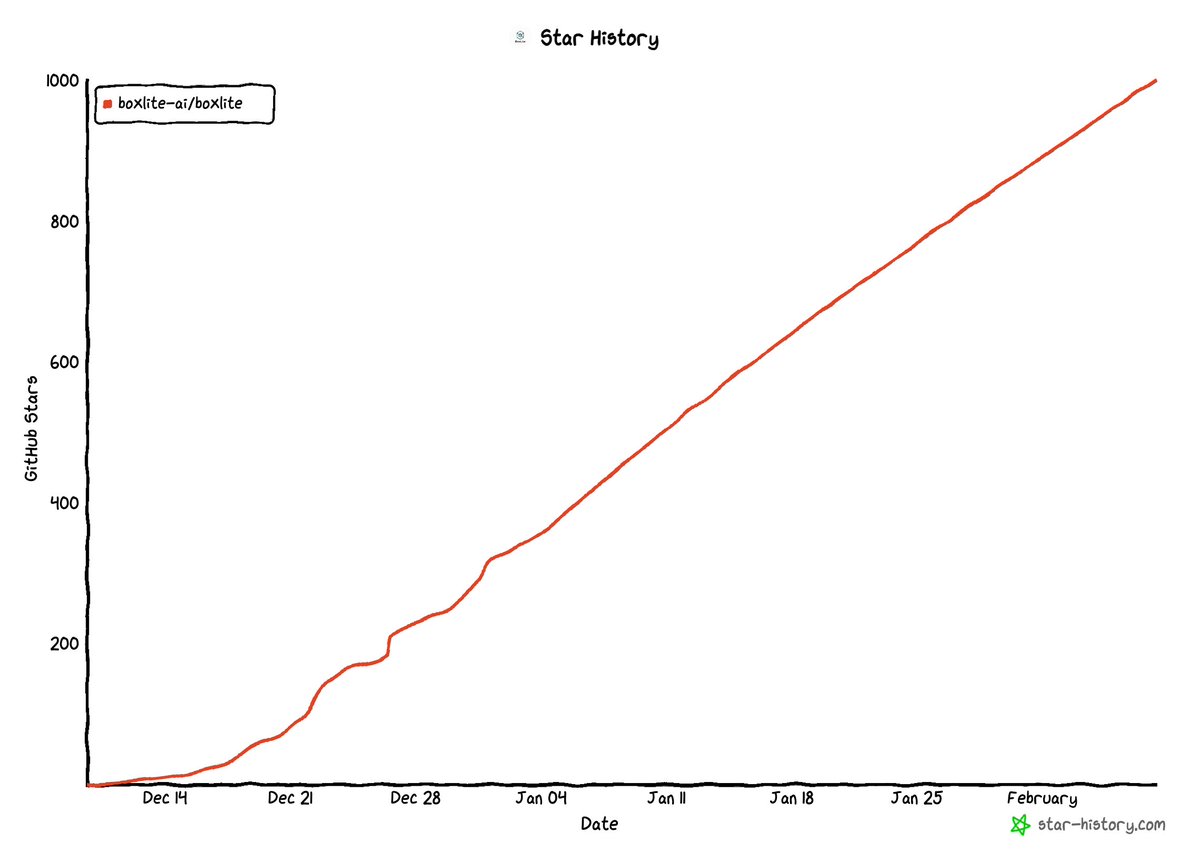
BoxLite just hit ~1k GitHub stars in ~2 months 🚀 Local-first, embeddable micro-VM sandbox for AI agents GitHub: github.com/boxlite-ai/box… If you’re looking for a out-of-box runtime for any of your agents(Claude Code, Codex, OpenClaw, in-house agents, etc). I’d love your feedback
Sandboxing OpenClaw in BoxLite VM. No budget for Mac mini? No problem!!! ``` pip install "boxlite[sync]" greenlet wget raw.githubusercontent.com/boxlite-ai/box… export CLAUDE_CODE_OAUTH_TOKEN="…" python clawboxlite.py ``` Then open: http://127.0.0.1:18789/chat?token=boxlite Enjoy!!!
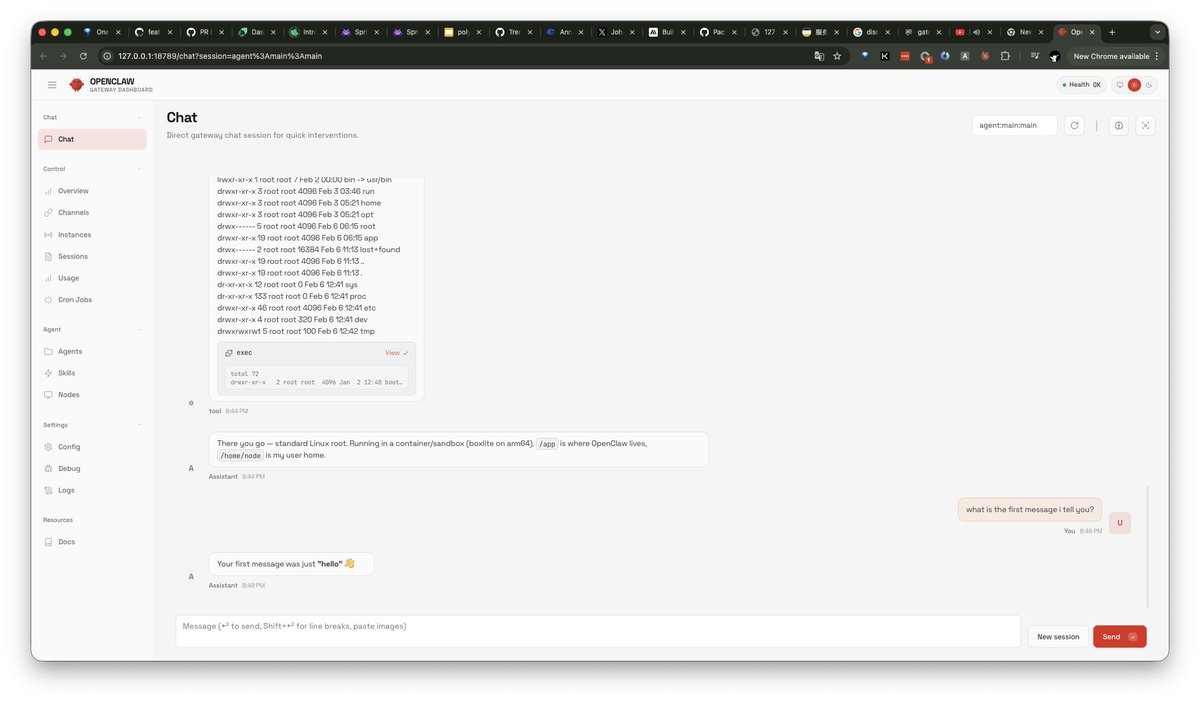
@loudoggeek We have a minimal OpenClaw + BoxLite example. It runs the OpenClaw Gateway in a BoxLite micro-VM with port forwarding + a persistent volume mount. ``` pip install "boxlite[sync]" wget raw.githubusercontent.com/boxlite-ai/box… export CLAUDE_CODE_OAUTH_TOKEN="…" python clawboxlite.py ```
@sxpstudio Ha, Vista UAC flashbacks! That's the problem with prompt-based security - fatigue leads to auto-approving. Sandboxing flips it: contain the blast radius by default, so you don't need to approve every action. Less friction, same safety.
@hueypov @heyandras @openclaw Fair point - SimpleClaw serves non-tech users well. But there's a middle ground: devs who know API keys but don't want to manage VMs/infra. That's where embedded sandboxes shine - pip install, no ops overhead, but still isolated. Different tools for different needs.
@jaehunshin_ @openclaw @Docker Yes, Docker Sandboxes is solid! They use microVM isolation (not just containers) so each agent gets its own kernel. Much safer than running directly on your main PC. Smart to sandbox first.
@Achex2026 @openclaw Running it directly on your main PC with full access carries some risk - agents can be unpredictable. Safest approach is an isolated environment (VM, container, or dedicated machine). At minimum, limit file/permission access and keep it away from sensitive credentials.
@FrancoSchiavone Great breakdown. For those who still want to experiment with OpenClaw, running it in an isolated environment is a solid first step. Micro-VMs can help - separate kernel means prompt injection can't escape to your host. github.com/boxlite-ai/box…
@SolutionsJoeG This is exactly right! Sandboxing is key for running AI agents safely. If you want the isolation without dedicating a whole machine, micro-VMs give you that same air-gap feeling but lighter weight. github.com/boxlite-ai/box…
@iamcadec @openclaw Running locally can be nice if you isolate it properly. We use micro-VMs so agents get full OS access but can't touch the host. Best of both worlds - local speed, VPS-level isolation. github.com/boxlite-ai/box…
@theobearman Core MCP trust problem: agents treat tool descriptions as ground truth. Even audited tools can change descriptions post-review. Architecture-level defense matters too - scope what each tool can access so a misleading description can't escalate into unrestricted privileges.
@ivanzugec @d4m1n Worth noting: that re-auth friction is the isolation doing its job. If an agent gets prompt-injected in one project, it can't access credentials from another. The env var approach works - just scope it per project rather than sharing a master key across all sandboxes.


Yuxuan Wang @log_pie
190 Followers 1K Following

BrianL | Building MuC... @lawChainHot
9 Followers 276 Following 🧑💻 Ex-Alibaba Dev 🔧 WebSocket DevTools 🏄🏻♂️ Vibe Coding 📱 Building @MuChills — Relax, start with body awareness
Gaussian @gaussianx
48 Followers 2K Following
Ryan ᵐᶠᵉʳ 🦄... @RyanMfer
3K Followers 813 Following I know nothing about AI—my work revolves around taste, culture, and build. Building culture @SparkLab_City
hluo @hluo243421
1 Followers 84 Following
Jim Yu @ivyliner
6K Followers 596 Following Maker & Problem Solver. I make apps: BeMyEars, YPlayer, Searchable, Falling,Lovely,汉字地图,FlameDisk... To solve real life problems.
Mamading Ceesay @evangineer
3K Followers 8K Following Polymath. Doing Work That Matters (@H_O_L_O_), Enabling Thrivable Futures, Shaping Worlds, Smithing Words, Telling Stories, Playing Tabletop Games. He/Him/His.
zzturtle @zztphoto
41 Followers 1K Following
凯哥 | kai.ge @AlphaBetaLuck
197 Followers 3K Following 野生码农,价值投机者,trading… 正在验证某种交易哲学 我的古法手工信息流:https://t.co/jnPMXo3XHb

SGZW @_SGZW
21 Followers 652 Following

大爷 @Dennis69249870
48 Followers 306 Following
YM @Peng1M
59 Followers 3K Following

schumi @hyschumi
0 Followers 200 Following
Himalaya @Himalayas1989
31 Followers 827 Following
Zero Liu @ZeroLiu462888
1 Followers 129 Following
J @KitLau_
21 Followers 1K Following
Software Engineering ... @sdegoodreads
15 Followers 448 Following Collection of public blogs/articles related to software engineering
🕹️ Alexander Gal... @emaxerrno
4K Followers 3K Following Founder & CEO of @RedpandaData. Building the Agentic Data Plane - https://t.co/xyvsqqV5OM. 🇨🇴


jianghao @destiny032517
25 Followers 391 Following
pentium3 @pentium_ii
501 Followers 1K Following
彩虹狗 @rainbowgo_
1 Followers 384 Following

Dorian @d0r1an_polygala
86 Followers 15 Following Building https://t.co/jSoWD7VA53: a micro-VM runtime for AI agents. Rust, OCI-compatible. Founder PolygalaAI — a cloud built for agents, not humans.
Yingjun Wu 🤘 @YingjunWu
4K Followers 1K Following Founder. Building the infra for agents and humans @RisingWaveLabs. Sharing what breaks, what doesn't, and what's next. ex-@awscloud, PhD @NUSingapore @CMUDB.
Shane @ShaneSmitas
486 Followers 846 Following Options trader since 2012. Building @getailyus. Dangerously skipping permissions. I, for one, welcome our new AI overlordsYou might like