Hello Interview @_hellointerview
Prepare for your upcoming SWE interviews! hellointerview.com/twitter Joined May 2023-
Tweets366
-
Followers527
-
Following2
-
Likes45
Full breakdown of cache invalidation and read scaling patterns: hellointerview.com/learn/system-d…
Knowing the names isn't the signal. Naming which failure mode you're willing to accept, and why, is what separates a candidate who's memorized patterns from one who's thought through the system.
Every cache eventually lies. The moment data lands in memory, it starts drifting from the source of truth. The question isn't whether to invalidate, it's which failure mode you're willing to accept.
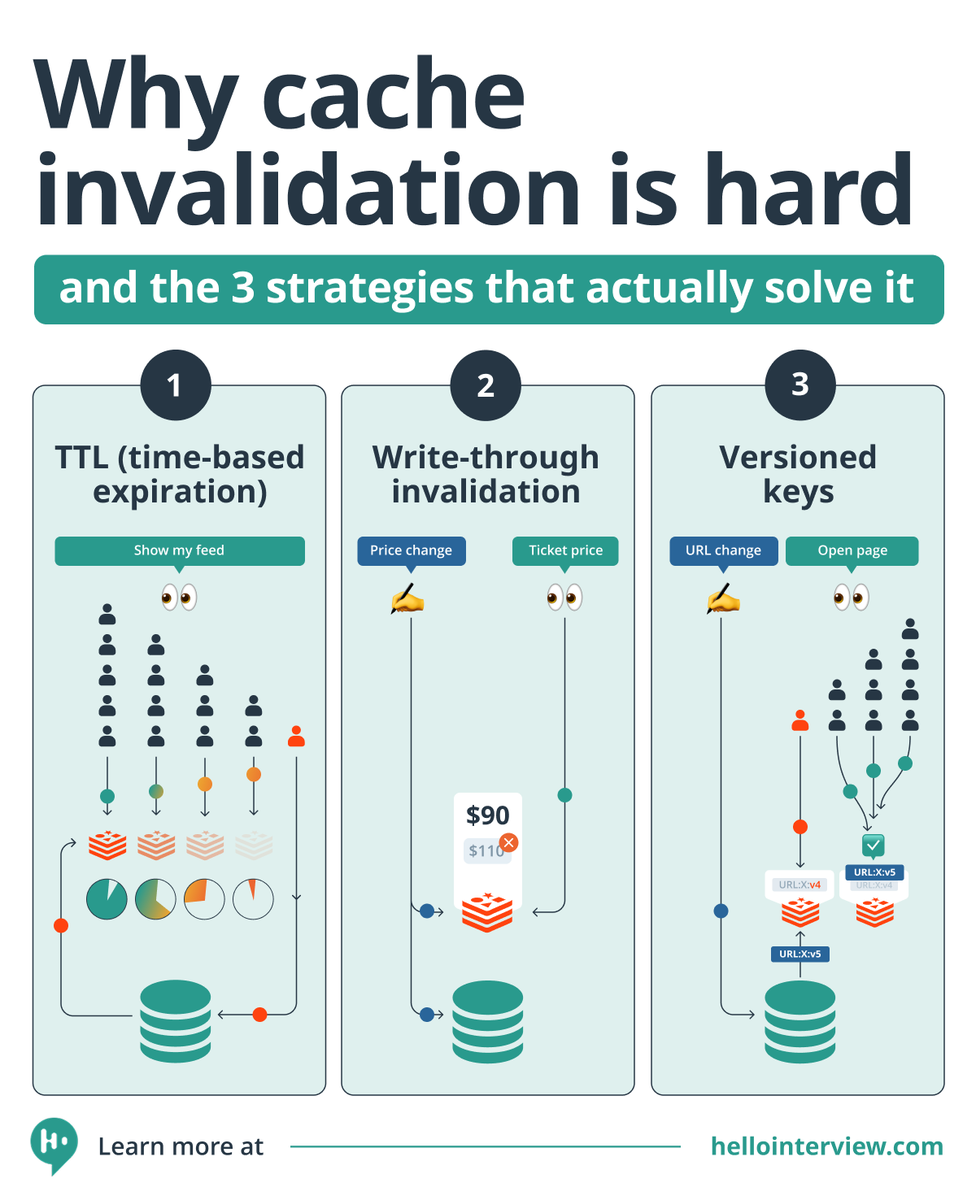
Cache invalidation is famously hard, and you've added a new failure surface. The speed gain is real, but so is the operational cost. That tradeoff is what makes caching a deliberate choice, not a default.
A cache like Redis sits between your app and your database, serving repeated reads from memory with no disk access. That's the difference between ~1ms and ~50ms per read. The tradeoff is you're now responsible for keeping that data consistent.
Read replicas and Redis both reduce load on your primary database. They're not interchangeable. They operate at different layers, and picking the wrong one for your bottleneck is a common system design mistake.

Pattern recognition over pattern matching. Practice it at hellointerview.com/learn/code/gre…
The signal interviewers want: can you recognize when greedy is valid, not just reach for DP because the problem mentions "minimum"?
Jump Game II looks like a DP problem. Choices at every step, a minimum to optimize, overlapping subproblems. It's greedy, and the reason why is worth understanding.

Kartik.rs @shipwithkartik
30 Followers 370 Following Software Engineer • IIIT Pune’24 • Next.js • Javascript • TypeScript • Performance-Driven UI • Rust🦀
Karl Müller @KarlMTech
7 Followers 71 Following
Shukran Jabbarov @jabbatrixx
88 Followers 1K Following While trying to learn, we ended up forgetting what we already knew.
Gaurav Mehta @gauravmehta043
4 Followers 92 Following
maldee @DeepakM57214064
6 Followers 87 Following "Senior Software Developer 💻 | Backend & Full-Stack Expert ⚙️ | Available for freelance projects & startup opportunities 🚀 | Building scalable solutions 🌐 |
Sean @Sean06287833285
16 Followers 1K Following

Gagan Jain @imGaganjain
28 Followers 381 Following
TheRustatian @rustatian
140 Followers 42 Following Golang/Rust Lead Software Engineer at @SpiralScout. GitHub: https://t.co/RoIbR3iDVX, LeetCode: https://t.co/0sDZsD3SH0

Alejandro Cuesta @alexcuesta
355 Followers 593 Following Surviving as Software Engineer and Father of Twins. Now: Ocado Technology. Previously: New Relic, https://t.co/rAyR7YbDKQ @[email protected]

Vimal Bera @vimalbera92
255 Followers 226 Following Coder by birth, wanderer by choice | SDE-3 @amazon | Loves products |
Hovnatan Karapetyan @hovnatan
86 Followers 760 Following

Sasidhar Reddy @Sasidha06198248
3 Followers 37 Following
Jack Reacher @JackReachett
3 Followers 546 Following
Hemant Narayan Yadav @dee_influencer
2 Followers 147 Following Software Engineer👨💻. Emotional in nature😄.Interested in solving critical problems.
ARTHUR NANGAI @noneguy_rt
1K Followers 2K Following another traveler on the journey of life | Software Tinkerer
Thiago Pereira @iam_thiago_
116 Followers 311 Following

Tejas Desai @tejas_desai10
43 Followers 70 Following software engineer, learner, dreamer. opinions are my own.
Devanshukoli @Devanshukoli
56 Followers 230 Following Backend Engineer | Typescript, JavaScript, Nodejs, MongoDB | #100DaysOfCode | Seeking opportunity to build scalable web apps
Aashish Moktan @MomoAniCode
0 Followers 8 Following Code. AI. Tech. | Software Engineer sharing what I'm learning
Hassaan @hassaan_ars
2 Followers 225 Following


Danish Parvez @_danishparvez
6 Followers 341 Following Software Engineer (Backend) | Go & Python | Data Structures & Algorithms | System Design
tushar srivastava @TSrivastava2803
0 Followers 40 Following
Yogesh Kumar @ygk4525
1 Followers 39 Following
NITIN BINDAL @NITINBINDA94570
6 Followers 15 Following
Abhigyan Dwivedi @AbhigyanDwivedi
4 Followers 56 Following
Hamza @BenlafkihH
142 Followers 352 Following
DAKSH veer @DAKSHveer2626
0 Followers 4 Following
Sheldon Claudius @shellxcloud
3 Followers 646 Following
Salma @muhsalaa
261 Followers 649 Following
Alireza.js🇮🇷 @alihd_js
7K Followers 535 Following AI & Tech Hunter | #JavaScript Alchemist | Professional Overthinker | #Guinness Lover | Show ‘em how the struggle made magic. جنوبیام
mohammed ujjainwala @ujjainwala_m
33 Followers 48 Following


Himanshu Patel @_Patel_Himanshu
146 Followers 805 Following Inquisitively exploring software engineering


zam🍉 @zsbahtiar
4K Followers 2K Following
RajaData @Technopreneurrr
10 Followers 769 Following
Jay Patel @jaympatel1893
542 Followers 2K Following Sr. Software Engineer @Snowflake, ML Feature Store, Streaming Ingestion, 📸 @usc Alumni. Plays 🎾. Investor/Trader, Opinions my own 😉

Stefan Mai @iamnafets
1K Followers 903 Following Builder. Older than all dogs. Creating: Hello Interview. Sold 2 startups, failed 1, ready for more. Previously ML eng leader FB, AMZN.You might like