Aakash @contextwindoww
Founder @ https://t.co/rJV052pQil Curious about products, people, power, and the systems underneath them. flares.in Delhi Joined May 2026-
Tweets42
-
Followers2
-
Following61
-
Likes22
This is a fascinating essay - quantum computing and AI and the acceleration of research, all together. There is much to unpack here. We should expect similar confluences between other technologies of strategic relevance. And expect them to happen faster and faster...

Today a crazy quantum story just got wilder. On March 31, the Google Quantum AI team published a landmark result on Shor's algorithm for elliptic curve cryptography. Technically, the paper was a bombshell: a dramatic 10x improvement over the state-of-the-art. As a stunt and

Opus 4.8 is live in Claude Code today. A few things worth knowing: 🧵

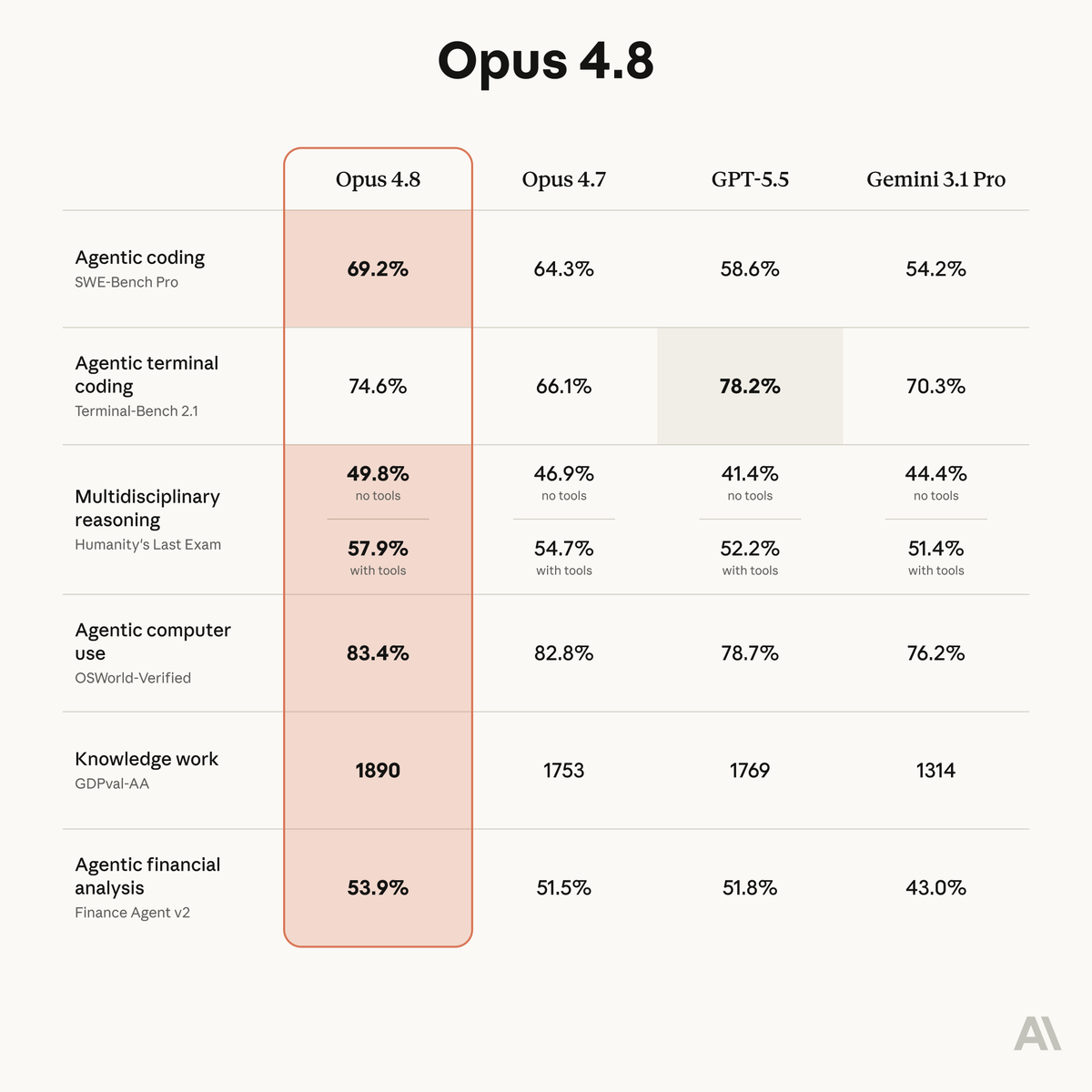
Introducing Claude Opus 4.8: it builds on Opus 4.7 with sharper judgment, more honesty about its own progress, and the ability to work independently for longer than its predecessors. Available today at the same price.
@StevBuilds For Flares.in? Absolutely. There's no other bug tracking tool who's even close.
I just finished this tremendously readable and provocative #book: Escape from Shadow Physics. The book is about foundations of quantum mechanics. To be precise, it’s about why we should not give up on trying to find a deeper theory of quantum mechanics. The usual story in QM is that the theory is complete and the probabilistic nature of our measurements is just the way nature is. Einstein famously rebelled against this, and didn’t accept it even until his death. Believe it or not, this attitude of his — “God does not play dice” — is in minority today. Most of the modern physicists believe that QM is complete, and that at the micro level reality is simply probabilistic when you make observations. In other words, there’s no deeper explanation to why we get statistical outcomes in QM experiments. Of course, this is so deeply unintuitive that there’s a cottage industry of interpretations for why is this the case. From multiverse to consciousness collapsing the wave function to multiple past timelines. All this would be super strange and crazy had QM not been confirmed experimentally to a high degree of accuracy. So, what is to be done? Should we just “shut up and calculate” and never ask what’s going on beneath the quantum levels. Is quantum mechanics final? The book is actually both a history of quantum mechanics but also a disguised guidebook on the history and philosophy of science. It goes back in time and talks about multiple accounts for when respected scientists suggested something was impossible, but later they turned out to be wrong. A striking example is that of heat. Fourier modeled its flow with an equation and that led many prominent scientists to believe that heat was a fluid. This made the alternative explanation — the kinetic theory of heat comprising atoms smashing with each another — open to getting attacked. Of course now we know what heat is at a much deeper level than anyone at that time could have anticipated; we now know heat is due to kinetic energy of atoms. Is the case similar with QM? Proponents of QM are quick to point to Bell’s Theorem — a supposedly “final” proof that there’s no deeper explanation to QM and that the reality it describes is just the way nature really is? The author does a great job of convincing how many such “impossibility” theorems often have hidden assumptions that are not fully elucidated that well render them weaker. What an impossibility theorem often shows is that the assumptions implicit in it cannot be violated. But there is often a lot of detail lurking in reality which we can’t fully anticipate in our theorems. So, it is best to view impossibility theorems as mathematical theorems and not necessarily a statements about physical reality. I think the book is hugely inspiring. I agree with its central message: we should allow dissenting voices that argue against finalities in our understanding. We should celebrate the fact that there are scientists who are not satisfied with the status quo. May future generations discover there are indeed “hidden variables” lurking in reality which fully explain the apparent statistical outcomes we observe in our quantum experiments!

AI outputs are increasingly becoming mirrors of operator quality. Same model. Different context. Different result.
it’s easy to dismiss something as mere “prompt engineering” but the right prompt can distill years and decades of highly non-trivial domain knowledge. in fact, as models keep getting smarter, their inability to get something done would likely be attributable to bad prompts.
Most bug reports are actually postmortems. By the time a user reports something: the failure has already propagated through production, affected workflows, frustrated users, and polluted support queues. Modern products need systems that notice operational drift before humans escalate it.
Software infrastructure still assumes humans are paying close attention. But AI-native teams are now shipping too fast for manual operational awareness to scale. That mismatch is going to create an entirely new generation of reliability tooling.
Interesting property of modern software: many production failures are technically “working.” Pages load. APIs respond. Nothing crashes. But users still struggle: dead clicks, retry loops, workflow abandonment, silent friction. Those are harder systems problems than obvious outages.
Absolutely!

This works really well btw, at the end of your query ask your LLM to "structure your response as HTML", then view the generated file in your browser. I've also had some success asking the LLM to present its output as slideshows, etc. More generally, imo audio is the
The problem with modern debugging isn’t lack of telemetry. It’s interpretation. Teams already have logs, replays, traces, metrics, support threads, and alerts. What they don’t have is a system that understands which weak signals actually matter. #debugging
Inteligence is now a commodity, taste is the new moat.
The operational surface area of software is increasing much faster than human attention scales. Feels like most infra categories over the next few years will emerge from that single imbalance.
People talk a lot about AI replacing coding. Much less discussion around AI replacing operational observation: monitoring drift, triaging anomalies, understanding regressions, tracking reliability patterns over time. That layer feels massively underbuilt right now.
A lot of AI products still feel like: “human workflow + chatbot layer.” The more interesting products are starting to remove the need for human vigilance entirely.
AI is quietly changing the shape of software teams. The interesting part isn’t that small teams can now build faster It’s that operational complexity no longer scales down with team size. A 2-person AI-native product can now generate the prod complexity of a 50-person co.
Twitter is becoming less of a social network and more of a real-time cognitive layer for the internet. Trends emerge here before they appear in reports, dashboards, or news cycles. Most companies still don’t know how to read it properly.
The future is not humans vs AI. It’s: people with AI systems vs people without them.
@buildwithshyam We're changing the way product issues/bug have been managed. Truly AI Native, from finding bugs before they're reported to resolving them with MCP. flares.in

As a developer, what is the easiest programming language to learn?

@StevBuilds @X Hi, let's connect! I am building flares.in for the new age of coding and product development. @flaresHQ

Palak Rajpoot @rajpoot_palakk
592 Followers 2K Following Climbed Maslow's Hierarchy but Upside Down.

Palak Rajpoot @rajpoot_palakk
592 Followers 2K Following Climbed Maslow's Hierarchy but Upside Down.

Steven @StevBuilds
2K Followers 970 Following New launch - https://t.co/PB4iUXUCH5 🔍https://t.co/rrzFiiHsuV ($800 MRR) 🏠 https://t.co/tjrkvPy6t7 ($2.4k MRR) ✨ https://t.co/4atGTNrU65 ($6k All-Time)
Priya @LoopandPixels
6K Followers 3K Following Learning: Mathematics, Physics, Economics and AI-ML - Thanks for checking my bio. Now go touch grass.
Matt Pocock @mattpocockuk
287K Followers 784 Following I teach devs for a living. Author of Total TypeScript and AI Hero. Ex-@vercel. Used to be a voice coach.
Captain Pleasure, And... @algekalipso
43K Followers 6K Following Views of a Transhuman neo-Buddhist from the future on sociology, artificial intelligence, mathematics, philosophy, neonoir film, and the post-singularity era.
Wingify Engineering @wingify_engg
439 Followers 13 Following The official account for Wingify Engineering.
Dileep George @dileeplearning
16K Followers 1K Following Head of AI @AsteraInstitute Prev: AGI @DeepMind, cofounder @vicariousai (acqd by Alphabet), cofounder @Numenta. IIT-Bombay, MS&PhD Stanford. https://t.co/IlsczdBtZo
Kevin Kwok @kevinakwok
35K Followers 5K Following
Joscha Bach @Plinz
159K Followers 795 Following
FQxI Physics @FQXi
20K Followers 5K Following Exploring the foundations of physics & cosmology with Zeeya Merali & Gabe Fitzpatrick, of the Foundational Questions Institute, FQxI.
José Luis Ricón Fer... @ArtirKel
24K Followers 1K Following Head of Theory at @RetroBio_ , enjoyer of things, blog: https://t.co/8xDYgWBhx9
Scott Alexander @slatestarcodex
165K Followers 38 Following I have a place where I say complicated things about philosophy and science. That place is my blog. This is where I make terrible puns.
ALife Papers @AlifePapers
2K Followers 14 Following Artificial Life papers. Accepting recommendations! Picture: Machina Docilis by G. Walter. By @sina_lana @moreau_austin @ISALstudents @caranha
Patrick Mineault @patrickmineault
23K Followers 3K Following NeuroAI researcher @ Amaranth Foundation, safety, open science. Previously engineer @ Google, Meta, Mila.
Jerry Neumann @ganeumann
26K Followers 1K Following
Brian Naughton @btnaughton
3K Followers 2K Following genetics/data/programming. ex-Hexagon ex-Stanford ex-23andMe ex-TCD https://t.co/77VRsi7znN 🇮🇪
Elliot Hershberg @ElliotHershberg
19K Followers 961 Following Partner @AmplifyPartners, writing https://t.co/LSbi0EEiHU
Nando de Freitas @NandoDF
111K Followers 895 Following I seek to understand intelligence, agency and awareness, and build AI aligned with compassion, freedom, universal human empowerment, and progress science.
Sam Whitmore @sjwhitmore
18K Followers 2K Following eng at @cursor_ai. not a cat (or a man) in real life. I like to run a lot! @newcomputer @kensho @harvard @StuyNY



AK @_akhaliq
504K Followers 3K Following AI research paper tweets, ML @Gradio (acq. by @HuggingFace 🤗) dm for promo ,submit papers here: https://t.co/UzmYN5XOCi
Nikita Bier @nikitabier
1.1M Followers 2K Following head of product @x, advisor @solana, venture partner @lightspeedvp, ex-founder @gasappteam (acq by discord), ex-founder @thetbhapp (acq by facebook)
Johan Norberg @johanknorberg
56K Followers 968 Following Classical liberal, Senior Fellow at the Cato Institute. New book: Peak Human – "Could a history book be more timely?" (The Economist)
Simon Willison @simonw
190K Followers 6K Following Creator @datasetteproj, co-creator Django. PSF board. Hangs out with @natbat. He/Him. Mastodon: https://t.co/t0MrmnJW0K Bsky: https://t.co/OnWIyhX4CH
Chris Olah @ch402
150K Followers 182 Following Reverse engineering neural networks at @AnthropicAI. Previously @distillpub, OpenAI Clarity Team, Google Brain. Personal account.

xjdr @_xjdr
28K Followers 689 Following building AI that wont embarrass me in front of my own standards
Teortaxes▶️ (Deep... @teortaxesTex
64K Followers 3K Following We're in a race. It's not USA vs China but humans and AGIs vs ape power centralization. @deepseek_ai stan #1, 2023–Deep Time «C’est la guerre.» ®1
Subbarao Kambhampati ... @rao2z
28K Followers 69 Following AI researcher & teacher @SCAI_ASU. Former President of @RealAAAI; Chair of @AAAS Sec T. Here to tweach #AI. YouTube Ch: https://t.co/4beUPOmf6y Bsky: rao2z
algoritmic @algoritmic
38K Followers 802 Following algorithmic, computational, emergent, complex, generative, parametric, procedural ... random inspiring stuff
Jakob Foerster @j_foerst
24K Followers 1K Following Associate Prof in ML @UniofOxford. Something Something Research Scientist @MetaAI. Something @FLAIR_Ox. Always #teamhuman. Opinions belong to the world.
Sander Dieleman @sedielem
68K Followers 2K Following Research Scientist at Google DeepMind (WaveNet, Imagen, Veo). I tweet about deep learning (research + software), music, generative models (personal account).


Sara Imari Walker @Sara_Imari
36K Followers 1K Following physics of life on this world and others ; Professor @ASU @SFIscience
Donald Hoffman @donalddhoffman
56K Followers 31 Following Professor Emeritus of Cognitive Sciences at the University of California, Irvine. Research: Visual perception, evolutionary psychology, consciousness, AI.
Chetaslua @chetaslua
25K Followers 152 Following AI Insider / Reporter featured in BGR • HackerNews • GIGAZINE • 36Kr | AI Prompting and Testing | Vibe Benchmark and Vibe Marketing 
Mathelirium @mathelirium
35K Followers 14K Following applied maths & stats, comp physics, & scientific visualizations. Want great visuals for your ML, Math, Physics paper or presentation? DM me for more details.
Kat ⊷ the Poet Engi... @poetengineer__
85K Followers 377 Following artist, engineer, researcher. live audio visual performer. artificial life, computation, neuroscience, machine psyche. science & art, futuristic & ancient.

yourclouddude @yourclouddude
26K Followers 88 Following Cloud | Python | AI Career Systems Structured guides, real projects & cert roadmaps 📌 Free resources below ↓ 🔗 https://t.co/dmySllL21u
Ryan Hoover @rrhoover
385K Followers 2K Following Founder of @ProductHunt. Investor at @WeekendFund. Say hi! 👋🏼
Jon Yongfook @yongfook
162K Followers 1K Following 🐻 https://t.co/KoqV5WRAhy image generation Bootstrapping SaaS @ $81K MRR
Daniel Nguyen @daniel_nguyenx
74K Followers 2K Following Builder. Bootstrapping @Bolt__AI (https://t.co/uenMr6HBDG - AI workspace for power users). Expect memes 😛You might like